Ski Goggle Lenses

Ski Goggles by Lens Type

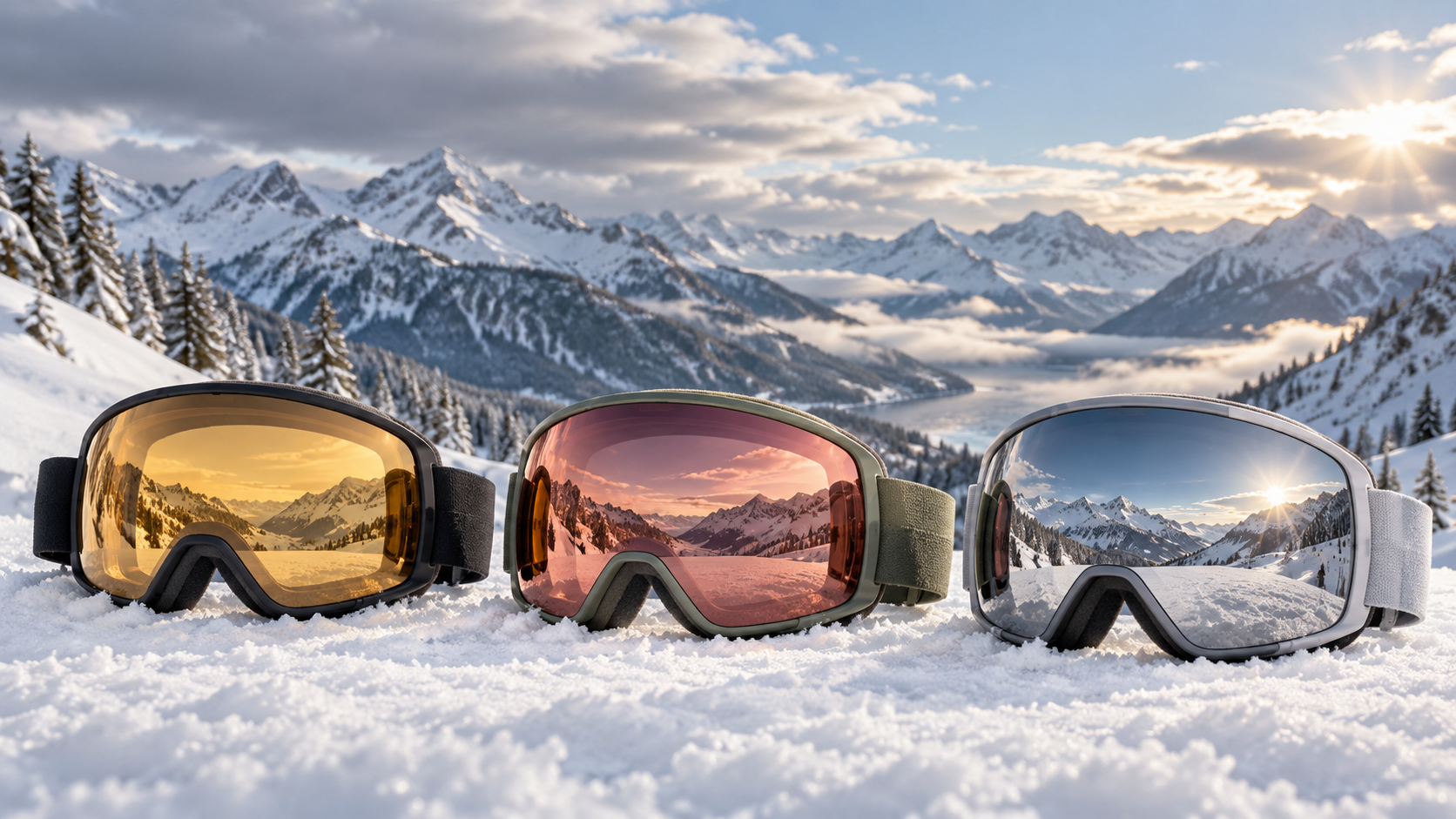
Goggles come with different lens types, from an all-round category 2 lens to photochromic lenses that automatically adjust to the light. Everyone has their favourites and over the years we’ve skiied in every category from S0 to S4 and found a good match for our needs initially with Bolle Modulators and later on with Uvex Variomatic photochromic lenses since the early 2010s. Our selections come from Uvex, Oakley and Salomon and all available on Amazon UK.
Advertisement / affiliate content. This page contains links to Amazon — if you buy through them, we may earn a commission at no extra cost to you.

Uvex Downhill 2100 CV Ski Goggles

If you want better visibility when the light shifts on the slopes, these Uvex goggles are worth a look. They use colourvision contrast enhancement alongside a Category 2 spherical lens for medium light. To stop them misting up when you are moving, there is a reliable anti-fog coating paired with a built-in frame ventilation membrane. They simply give you a clear and comfortable view for a full day on the mountain.

Why we like this

  • Category 2 spherical lens for 19-43% light transmission.
  • Built-in uvex colorvision technology to sharpen contrast.
  • Integrated frame ventilation membrane to help airflow.
  • Anti-fog coating to reduce condensation in changing temperatures.

Uvex Downhill 2100 V Photochromic Ski Goggles

If you don’t want the hassle of swapping lenses as the weather turns, these photochromic goggles are worth a look. The lens automatically shifts between filter categories 1 and 3, handling flat light and bright sun alike. That’s backed up by contrast-enhancing tech and an anti-fog coating to keep your view clear throughout the day.

Why we like this

  • The photochromic lens adjusts across filter categories 1 to 3 as conditions change.
  • uvex colorvision improves contrast and colour perception.
  • The anti-fog coating stops them misting up when you’re working hard.
  • Decentred optical lenses provide a distortion-free view across your whole field of vision.

Oakley Flight Deck XM Ski Goggles

If you want goggles with swappable lenses and room for glasses, the Oakley Flight Deck XM is worth a look. They feature Prizm lenses to help boost contrast on the slopes, a dual-lens setup that meets EN 174 safety standards, and subtle notches in the frame so you can wear them over most standard glasses.

Why we like this

  • Easy lens swapping with the Ridgelock system
  • Room for most prescription glasses thanks to frame notches
  • Good contrast and terrain visibility from the Prizm lenses
  • Certified to EN 174 safety standards

Oakley Line Miner M Ski Goggles

Skiers and snowboarders with medium-sized faces looking for reliable eye protection on bright days might want to consider the Oakley Line Miner M Ski Goggles. With a filter category 3 rating and Oakley’s Prizm lens technology, these goggles work well in strong sunshine by boosting contrast and terrain definition. They provide a comfortable medium fit and good optical clarity for sunny mountain conditions.

Why we like this

  • Filter category 3 rating for strong sunshine.
  • Prizm lens technology to enhance contrast and terrain details.
  • Comfortable medium fit for average face shapes.

Salomon S/View 3 Access Ski Goggles

For resort skiing and snowboarding, these goggles offer dependable all-mountain performance in shifting weather. The lens cuts brightness and glare in both sun and overcast light, ventilation helps stop them steaming up, and they are made to work with Salomon Pioneer helmets.

Why we like this

  • A wide field of vision.
  • The lens handles bright sunshine and dull, flat light.
  • Built-in ventilation reduces fogging during runs.
  • Pairs with Salomon Pioneer helmets for a comfortable fit.

As an Amazon Associate we earn from qualifying purchases.

Verdict

Our top pick is the Uvex Downhill 2100 V Photochromic Ski Goggles. These combine uvex colorvision contrast enhancement and supravision anti-fog with photochromic lenses that adjust across filter categories 1 to 3. They also use optical grade 1 decentred lenses, giving you clear vision and adaptation to changing conditions without needing to swap lenses.

The runner-up is the Oakley Flight Deck XM Ski Goggles, which work well if you have different priorities. They are a sensible choice if you wear glasses, as the frame has notches that fit most prescription frames. They also feature the Ridgelock lens change system, Prizm lens options, and meet EN 174 safety standards.

The Knowledge

Anti-fog coating

A treatment on the inside of a goggle lens that helps stop condensation forming. Most good goggles pair it with a double lens and…

Anti-fog coating

An anti-fog coating is a treatment on the inside of a goggle lens that stops condensation forming as tiny droplets. Instead, moisture spreads into an invisible film, so you can still see through it.

Why goggles fog

Fog forms when warm, damp air from your face meets a cold lens. Most good goggles fight it three ways: the coating, a double lens with an insulating gap between its two layers (which keeps the inner layer warmer), and vents that let moist air out. Fogging tends to happen when you stop moving, such as in a queue or on a slow chairlift, and when you are hot and sweaty from a hard run.

Looking after it

  • Never wipe the inside of the lens, especially with a glove. The coating is soft and rubs off.
  • If snow gets inside, shake it out and let the lens dry. Dab the outside only, with the microfibre bag the goggles came in.
  • Dry goggles at room temperature overnight, not on a radiator or in front of a fire, which can damage the coating and the foam.
  • Don’t push goggles up onto a sweaty forehead or a hat: they collect warm moisture and fog the moment you pull them down.
  • Keep vents clear of snow and avoid covering the top vents with a tight hat.

A worn coating can’t really be restored. If an older pair fogs constantly, a replacement lens is usually cheaper than new goggles, and a spare lens is useful anyway. Glasses wearers should see OTG goggles too.

Lens category (S0 to S4)

Goggle and sunglass lenses are graded into five filter categories, 0 to 4, often printed as S0 to S4. Category 1 suits flat light…

Lens category (S0 to S4)

Goggle and sunglass lenses are sorted into five filter categories, numbered 0 to 4 and often printed as S0 to S4 or “Cat. 3” on the lens or packaging. The number tells you how dark the lens is, based on how much light it lets through (its VLT).

Which category for which conditions

  • Category 0: clear or nearly so, for night skiing and very gloomy light.
  • Category 1: flat light, low cloud and snowfall, when you need every bit of contrast.
  • Category 2: the all-rounder for mixed sun and cloud, and the most useful single lens for a typical holiday.
  • Category 3: bright, sunny days, which the Alps produce plenty of in March.
  • Category 4: extreme glare at altitude, on glaciers and high snowfields.

Things worth knowing

Category 4 lenses must carry a warning that they are not suitable for driving: they cut too much light to read the road and traffic signals safely. Darker categories are also unsuitable for driving at night or at dusk, which matters if you wear the same sunglasses for the drive home.

The category is about brightness, not protection. A category 1 lens can block UV just as well as a category 4 one, so look for “100% UV protection” or “UV400” as well.

Lens colour changes how things look rather than the category: rose, amber and yellow tints sharpen contrast in flat light, while grey and neutral tints keep colours true in sunshine. Many goggles come with two lenses, one bright-day and one low-light, which covers the whole range between them.

OTG (over the glasses)

Goggles with a deeper frame and cut-outs in the foam so they fit over prescription glasses. Not every pair of glasses fits every OTG…

OTG (over the glasses)

OTG stands for “over the glasses”. OTG goggles have a deeper frame and channels or cut-outs in the face foam, so they can be worn over prescription spectacles without pressing the arms into your temples or pushing the glasses onto your nose.

Making it work

  • Take your own glasses when buying. Not every frame fits every OTG goggle; small, light frames with thin arms fit most easily.
  • Fogging is the main enemy, because there are two lenses to mist up and your glasses sit in the warm air from your face. A goggle with a double lens, good vents and an anti-fog coating matters even more than usual.
  • An anti-fog treatment or wipe on the spectacle lenses themselves helps too.
  • Keep moving on cold lifts if you can, and avoid pushing the goggles up onto your forehead.

Alternatives

Many people who wear glasses ski in contact lenses, often daily disposables, and wear ordinary goggles. Some goggle makers sell prescription inserts: a small frame with your prescription that clips inside the goggle. Visor helmets are another option, as most visors leave room for glasses underneath.

For children

Children who wear glasses tend to put up with a lot of fogging before they say anything. An OTG goggle that fits their frames properly, tried on with their helmet, is worth the effort. Check it doesn’t leave a gaper gap.

Photochromic lens

A lens that darkens in bright light and clears again in shade or cloud, reacting mainly to ultraviolet light. Ski goggle versions usually cover…

Photochromic lens

A photochromic lens darkens in bright light and clears again in shade or cloud, so one lens can cover changing conditions through a day. It reacts mainly to ultraviolet light: molecules in the lens change shape when UV hits them, which deepens the tint.

How much it changes

Ski goggle versions typically move between category 1 and 3, from flat-light pale to bright-sun dark. A few cover categories 1 to 2 or 2 to 3. That range suits the classic Alpine day of a bright morning, cloud building over lunch and a grey final run.

What they can’t do

  • They darken faster than they clear. Skiing from sun into a shaded gully, the lens can stay darker than you would like for a minute or so.
  • Cold makes the lens darker and slower to change, which is useful on a freezing sunny day and less helpful at dusk.
  • They hardly react behind glass, because windscreens and windows block most UV. Don’t judge one in a shop window or a car.
  • They aren’t a substitute for a clear lens at night.

Who they suit

Photochromic goggles suit anyone who doesn’t want to carry or swap a second lens, including children and beginners. People who ski in very flat light a lot may still prefer a dedicated low-light lens with a contrast-boosting tint. Our photochromic goggles article goes into more detail.

Spherical and cylindrical lenses

A cylindrical lens curves from side to side but is flat from top to bottom. A spherical lens curves both ways, a bit like…

Spherical and cylindrical lenses

These terms describe the shape of a goggle lens. A cylindrical lens curves from side to side, around your face, but is flat from top to bottom. A spherical lens curves in both directions, like a slice of a ball, roughly following the shape of the eye.

What difference it makes

A spherical lens generally gives a wider field of view, particularly up and down, and less distortion towards the edges, because your eye looks through it at a more even angle. The extra volume inside the goggle also helps air circulate, which can reduce fogging.

Cylindrical lenses are flatter and lower-profile, which some people prefer for looks and for fit with certain helmets. They are often cheaper, and good ones are perfectly clear in the middle where you do most of your looking.

Toric and other shapes

A toric lens sits between the two: curved in both directions, but more gently from top to bottom than a full spherical lens. Makers sometimes use their own names for these shapes, so read the description rather than the brand name.

Does it matter for you?

For a week’s holiday skiing, the fit around your face and with your helmet matters more than lens shape, along with the right lens category. Shape becomes more noticeable for people who ski fast, ski a lot in trees or flat light, or simply notice edge distortion. If you can, try both on and look around at the edges of your vision.

VLT (visible light transmission)

The percentage of visible light a goggle lens lets through. The lower the figure, the darker the lens. VLT decides the lens category: roughly…

VLT (visible light transmission)

Visible light transmission is the percentage of visible light a goggle or sunglass lens lets through to your eyes. A clear lens lets through nearly all of it; a dark mirrored lens for glacier sun might let through as little as 5%. The lower the figure, the darker the lens.

How it relates to lens categories

VLT is what decides a lens’s filter category. The bands are roughly:

  • Category 0: 80 to 100% (clear, for night or very dull light)
  • Category 1: 43 to 80% (flat light, cloud and falling snow)
  • Category 2: 18 to 43% (mixed conditions, the all-rounder)
  • Category 3: 8 to 18% (bright sun)
  • Category 4: 3 to 8% (extreme glare, high glaciers)

Brands round these a point or two differently, so a lens sold as 18% might be listed as category 2 by one maker and category 3 by another.

What to look for

If you only own one pair of goggles for a week in the Alps, a lens of around 15 to 25% VLT copes with most days. Keen skiers often carry a second, lighter lens (50% or more) for storms and flat light, or choose a photochromic lens that changes its VLT on its own.

VLT says nothing about UV protection. A properly made lens blocks harmful UV whether it is pale or dark, so check for “100% UV” or “UV400” separately.

We use cookies to personalise content and ads, to provide social media features and to analyse our traffic. We also share information about your use of our site with our social media, advertising and analytics partners. View more
Cookies settings
Accept
Decline
Privacy & Cookie policy
Privacy & Cookies policy
Cookie name Active

Who we are

Suggested text: Our website address is: http://theskiroom.co.uk.

Comments

Suggested text: When visitors leave comments on the site we collect the data shown in the comments form, and also the visitor’s IP address and browser user agent string to help spam detection. An anonymised string created from your email address (also called a hash) may be provided to the Gravatar service to see if you are using it. The Gravatar service Privacy Policy is available here: https://automattic.com/privacy/. After approval of your comment, your profile picture is visible to the public in the context of your comment.

Media

Suggested text: If you upload images to the website, you should avoid uploading images with embedded location data (EXIF GPS) included. Visitors to the website can download and extract any location data from images on the website.

Cookies

Suggested text: If you leave a comment on our site you may opt in to saving your name, email address and website in cookies. These are for your convenience so that you do not have to fill in your details again when you leave another comment. These cookies will last for one year. If you visit our login page, we will set a temporary cookie to determine if your browser accepts cookies. This cookie contains no personal data and is discarded when you close your browser. When you log in, we will also set up several cookies to save your login information and your screen display choices. Login cookies last for two days, and screen options cookies last for a year. If you select "Remember Me", your login will persist for two weeks. If you log out of your account, the login cookies will be removed. If you edit or publish an article, an additional cookie will be saved in your browser. This cookie includes no personal data and simply indicates the post ID of the article you just edited. It expires after 1 day.

Embedded content from other websites

Suggested text: Articles on this site may include embedded content (e.g. videos, images, articles, etc.). Embedded content from other websites behaves in the exact same way as if the visitor has visited the other website. These websites may collect data about you, use cookies, embed additional third-party tracking, and monitor your interaction with that embedded content, including tracking your interaction with the embedded content if you have an account and are logged in to that website.

Who we share your data with

Suggested text: If you request a password reset, your IP address will be included in the reset email.

How long we retain your data

Suggested text: If you leave a comment, the comment and its metadata are retained indefinitely. This is so we can recognise and approve any follow-up comments automatically instead of holding them in a moderation queue. For users that register on our website (if any), we also store the personal information they provide in their user profile. All users can see, edit, or delete their personal information at any time (except they cannot change their username). Website administrators can also see and edit that information.

What rights you have over your data

Suggested text: If you have an account on this site, or have left comments, you can request to receive an exported file of the personal data we hold about you, including any data you have provided to us. You can also request that we erase any personal data we hold about you. This does not include any data we are obliged to keep for administrative, legal, or security purposes.

Where your data is sent

Suggested text: Visitor comments may be checked through an automated spam detection service.
Save settings
Cookies settings