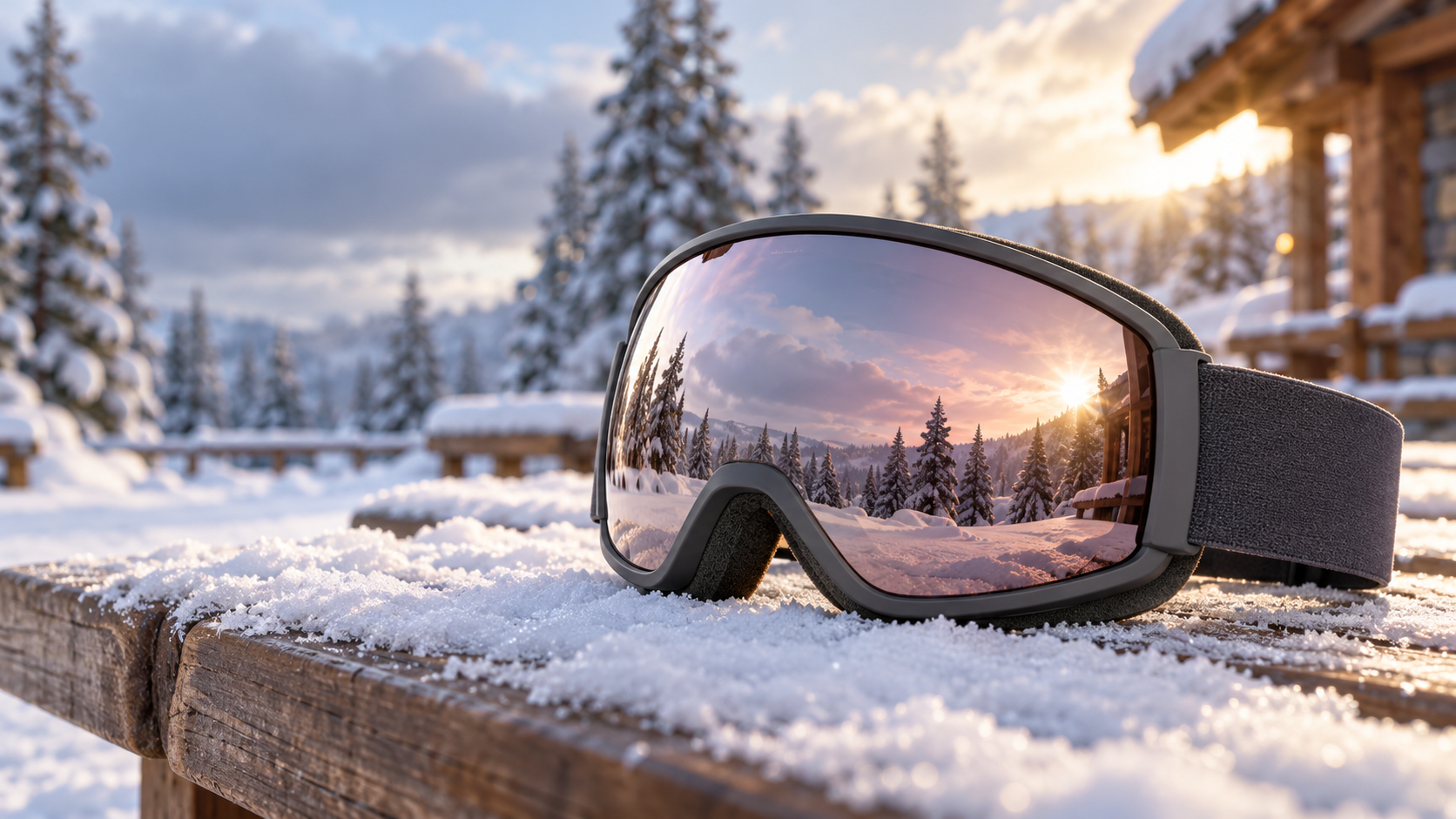
A photochromic lens darkens in bright sun and lightens again when the cloud comes in, so one goggle can see you through the whole day without a spare lens in your pocket. Our guide Ski Goggle Lenses Explained covers lens categories in general. This piece looks at photochromic lenses in more detail, with five goggles worth considering.
The idea started with glass, not goggles. In 1964 two Corning chemists, William Armistead and Donald Stookey, applied for a patent on glass containing tiny crystals of silver halide, which darken under ultraviolet light and clear again when it goes. The first photochromic spectacle lenses went on sale the following year. Plastic photochromic lenses followed in the early 1990s, and those are what goggles use today. The chemistry has moved on, but the trick is the same.
How a photochromic lens works
The lens reacts mainly to ultraviolet light. In strong sun it darkens. In shade, cloud or falling snow, where there is less UV, it gradually clears. Its range is given as lens categories, and all five goggles below run from category 1, for flat light, to category 3, for bright sunshine.
Three categories is the number they cover, and for most skiers that is enough, from a grey morning to a bluebird afternoon. Four is the darkest category, for glaring days on glaciers and very high peaks, and none of these lenses goes that far. Five is right out, as there isn’t one.
What affects it
- Speed. A photochromic lens darkens faster than it clears. Ski from bright sun into a shaded gully and the lens can stay darker than you’d like for a little while.
- Temperature. Cold makes the lens go darker and clear more slowly. That suits a bright, freezing day, but it makes the change back in the shade slower still.
- Glass. Car windscreens block most UV, so a photochromic lens won’t darken much behind one. Not that ski goggles make good driving glasses.
What else to look for
- If you wear glasses, look for an OTG (over the glasses) frame with room for your specs. The Bollé Y7 OTG below is built for this.
- A swappable lens still has its uses with photochromic goggles. Category 1 is as light as these lenses go, so if you ski under floodlights, a clear category 0 lens is lighter. The HEAD Contex Photo’s lens is interchangeable.
- Polarisation cuts glare off the snow, though some skiers find it makes icy patches harder to spot. Bollé’s Phantom+ lens is half polarised as a compromise.
- Fit with your helmet. Try goggles with the helmet you’ll wear, and check there’s no gap of bare forehead between the two.
Five photochromic goggles
Uvex’s Downhill 2100 V and Pyrit V both use Uvex’s variomatic photochromic lens. Salomon’s Radium Photo has a frame that adapts to the shape of your face, Bollé’s Y7 OTG is the one for glasses wearers, and HEAD’s Contex Photo has a lens you can swap. All five cover categories 1 to 3 and are available on Amazon UK.
Read next: Ski Goggle Lenses Explained · Ski Visor Helmets — Robocop or Revelation?