Ski Visor Helmets

Visor Ski Helmets: Our Picks

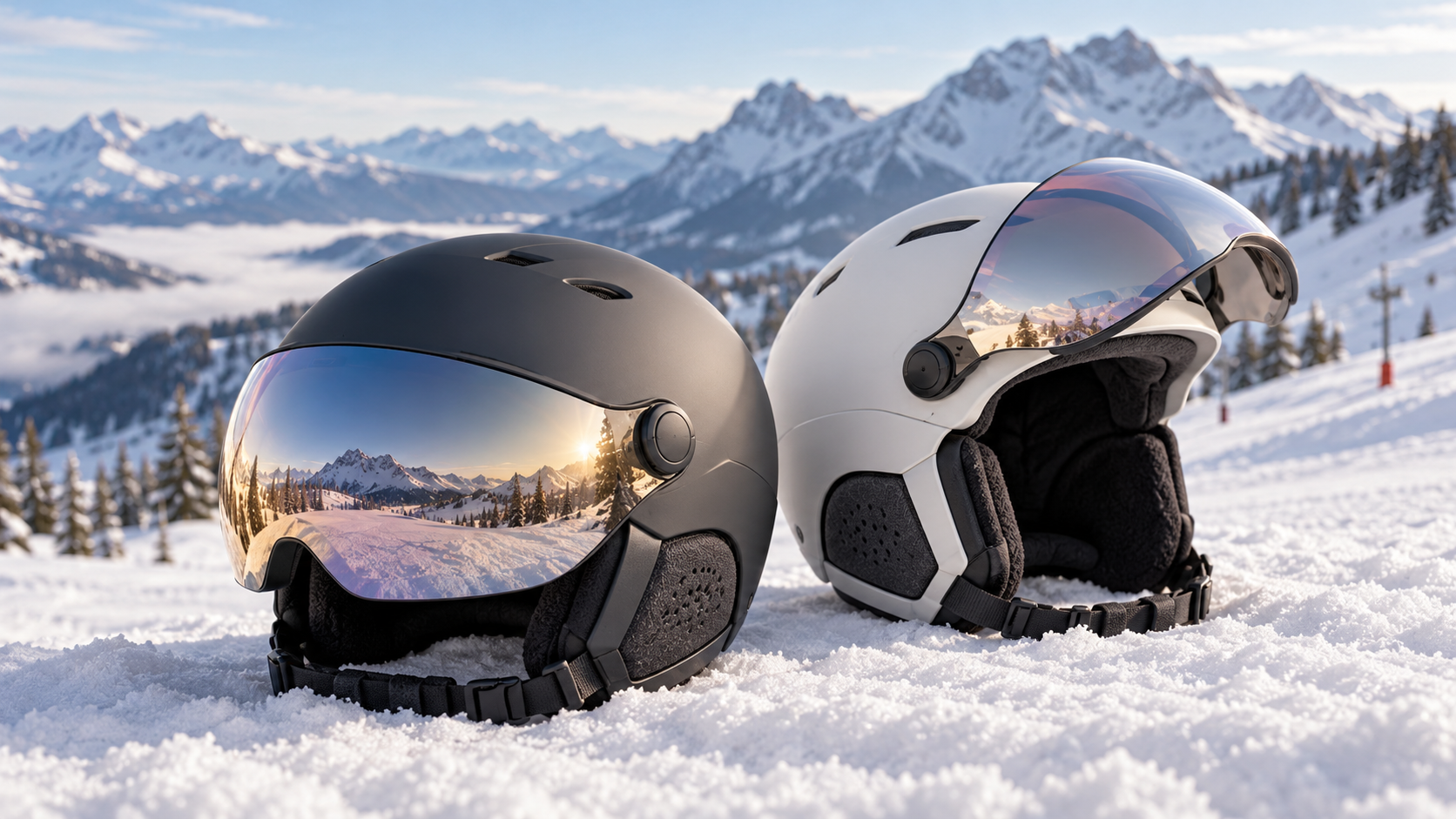
A visor helmet combines a helmet and goggles in one. These are well-known models from Atomic, Uvex, Alpina and Salomon, all available on Amazon UK. Try one on with the glasses you’ll wear underneath if you can.
Advertisement / affiliate content. This page contains links to Amazon — if you buy through them, we may earn a commission at no extra cost to you.

Uvex Wanted Visor Ski Helmet

Combining a visor and helmet in one, the Uvex Wanted is worth a look if you prefer not to wear separate goggles. It uses a hardshell exterior paired with an EPS inner core for impact protection, and the built-in visor has Category 2 lens filtration for mixed light. You also get a customisable uvex IAS fit system and adjustable closable ventilation to help keep you comfortable.

Why we like this

  • The built-in Category 2 visor handles changing light conditions.
  • The hard outer shell and EPS inner shell provide solid protection.
  • Closable ventilation helps you regulate your temperature.
  • The uvex IAS system makes it easy to adjust the fit.

Uvex Instinct Visor Ski Helmet

Skiers and snowboarders looking for a combined helmet and visor setup might want to consider the Uvex Instinct Visor Ski Helmet. It features a hard outer shell paired with an EPS inner core, along with a category 2 integrated visor that has a 19 to 43 percent transmission rate for variable light. You can adjust the fit using the uvex IAS system and control your temperature with the closable ventilation channels.

Why we like this

  • Category 2 visor for variable light conditions.
  • Hard outer shell and EPS inner layer.
  • Adjustable uvex IAS fit system.
  • Closable ventilation channels for temperature control.

Alpina Arber Visor Q-Lite Ski Helmet

This visor helmet from Alpina suits skiers and snowboarders who want to combine a helmet and goggles in one piece of kit. It uses a hard shell design with built-in ear covers for protection and warmth on the slopes. The Q-Lite visor improves visibility in varying light, and the helmet also features an integrated venting system and a neck warmer for temperature control.

Why we like this

  • Hard shell construction with attached ear covers for protection.
  • Q-Lite visor provides vision without needing separate goggles.
  • Built-in venting system helps manage airflow.
  • Neck warmer helps block out cold drafts.

Salomon Orka Visor Kids’ Ski Helmet

A good choice for young skiers, the Salomon Orka Visor Kids’ Ski Helmet combines comfort and protection on the slopes. The in-mould shell keeps the weight down, and the integrated Flash visor means there is no need for separate goggles. A Custom Dial adjustment makes it easy to get a secure fit that adapts as your child grows.

Why we like this

  • The lightweight in-mould shell keeps the weight down for all-day comfort.
  • The built-in visor means children have no separate goggles to misplace.
  • The Custom Dial adjustment system accommodates growing heads.

Atomic Visor Stereo Ski Helmet with Built-In Visor

Skiers looking to pack a bit lighter without cutting corners might get on well with the Atomic Visor Stereo Ski Helmet. It features a built-in visor with Stereo lens technology, impact-absorbing Holo Core construction, and adjustable ventilation for temperature control on the slopes. The visor also accommodates prescription glasses underneath.

Why we like this

  • Integrated visor means you can leave separate goggles at home
  • Accommodates glasses underneath the visor
  • Holo Core construction provides protection against impacts
  • Adjustable ventilation lets you control airflow while skiing

As an Amazon Associate we earn from qualifying purchases.

Verdict

The Atomic Visor Stereo Ski Helmet is our overall winner. It combines Holo Core construction for protection with adjustable ventilation and a built-in visor. The Stereo lenses can be adjusted to fit over glasses, which makes it a comfortable option for the slopes.

The Salomon Orka Visor Kids’ Ski Helmet is our runner-up. It is designed specifically for younger skiers rather than adults, using a lightweight in-mould shell and a Custom Dial adjustment system to fit growing heads.

The Knowledge

EN 1077

The European safety standard for ski and snowboard helmets. Class A helmets cover the ears and pass a tougher impact and penetration test; class…

EN 1077

EN 1077 is the European safety standard for helmets used for alpine skiing and snowboarding. A helmet sold for skiing in the UK or EU should be tested to it and marked inside, usually on a label under the padding.

Class A and class B

The standard has two classes:

  • Class A helmets cover more of the head, including the ears, and must pass a tougher penetration test. They are the more protective of the two.
  • Class B helmets can leave the ears partly uncovered and allow more ventilation, and are tested to a slightly lower level. Most recreational ski helmets with soft ear pads are class B.

Both classes are tested for shock absorption, penetration, retention (whether the chin strap and buckle hold) and field of view.

Other standards

Many helmets also meet ASTM F2040, the American standard for recreational snow sports helmets. Racing helmets may carry stricter ratings as well. Extra features such as MIPS are not part of EN 1077 itself.

Practical points

  • Standards only help if the helmet fits; see helmet sizing.
  • Replace a helmet after any hard knock, even if it looks fine. The foam inside is designed to crush once and won’t protect as well a second time.
  • Many makers suggest replacing a helmet every five years or so, as materials age.
  • Second-hand helmets are best avoided, as you can’t know their history.

Helmet sizing

Ski helmets are sized by head circumference, measured around the head about a centimetre above the eyebrows. A good fit sits level and snug…

Helmet sizing

Ski helmets are sized by head circumference in centimetres, usually in bands such as S (52 to 55cm), M (55 to 59cm) and L (59 to 63cm). Every brand’s bands differ slightly, so measure before buying rather than going by your size in another make.

How to measure

Wrap a soft tape measure around the widest part of the head: about a finger’s width above the eyebrows at the front, over the tops of the ears, and around the bump at the back. Take two or three measurements and use the largest. For children, measure on the day you buy; heads grow faster than you’d think.

How a good fit feels

  • Snug all round, with no pressure points or gaps, especially at the temples.
  • Level on the head, with the front sitting about a finger’s width above the eyebrows, not tipped back.
  • It should move the skin of the forehead when you push it gently side to side, rather than sliding over it.
  • With the chin strap fastened, you should fit one finger between strap and chin, and the helmet shouldn’t roll off forwards or backwards.

Practical tips

  • Most helmets have an adjustment dial at the back for fine tuning, but it can’t fix a helmet that is the wrong size.
  • Wear only a thin hat or balaclava underneath, never a thick bobble hat.
  • Try it with your goggles to avoid a gaper gap.
  • Don’t buy children a helmet to grow into: a loose helmet protects poorly.

See also EN 1077 and MIPS.

In-mould, hard shell and hybrid helmets

An in-mould helmet has a thin polycarbonate shell fused to its foam liner as it is moulded, which keeps the weight down. A hard-shell…

In-mould, hard shell and hybrid helmets

These are the three common ways ski helmets are built. All three have a liner of expanded polystyrene (EPS) foam, which does the real work in a crash by crushing to absorb the energy. The difference is the shell on the outside.

In-mould

A thin polycarbonate shell is fused to the foam as the liner is moulded, so the two become a single piece. In-mould helmets are light and well ventilated, and the most common type for recreational skiing. The thin shell scuffs and dents more easily, so they need a little more care when carried and stored.

Hard shell

A thicker shell of ABS plastic is made separately and fixed over the foam liner. Hard-shell helmets are heavier but shrug off knocks, ski edges and being thrown in a car boot, which makes them popular for children, rental fleets and park riders.

Hybrid

A hybrid combines the two, usually with a hard ABS top where knocks are most likely and in-mould construction around the sides and back to save weight. Many mid-price helmets use it.

Which to choose

All three can pass the same safety standard, EN 1077, so construction is more about weight, durability and price than protection. Fit matters most of all (see helmet sizing). Whatever the type, replace a helmet after a significant impact: once the EPS foam has crushed, it doesn’t spring back. Some helmets add a rotational-impact layer such as MIPS.

Lens category (S0 to S4)

Goggle and sunglass lenses are graded into five filter categories, 0 to 4, often printed as S0 to S4. Category 1 suits flat light…

Lens category (S0 to S4)

Goggle and sunglass lenses are sorted into five filter categories, numbered 0 to 4 and often printed as S0 to S4 or “Cat. 3” on the lens or packaging. The number tells you how dark the lens is, based on how much light it lets through (its VLT).

Which category for which conditions

  • Category 0: clear or nearly so, for night skiing and very gloomy light.
  • Category 1: flat light, low cloud and snowfall, when you need every bit of contrast.
  • Category 2: the all-rounder for mixed sun and cloud, and the most useful single lens for a typical holiday.
  • Category 3: bright, sunny days, which the Alps produce plenty of in March.
  • Category 4: extreme glare at altitude, on glaciers and high snowfields.

Things worth knowing

Category 4 lenses must carry a warning that they are not suitable for driving: they cut too much light to read the road and traffic signals safely. Darker categories are also unsuitable for driving at night or at dusk, which matters if you wear the same sunglasses for the drive home.

The category is about brightness, not protection. A category 1 lens can block UV just as well as a category 4 one, so look for “100% UV protection” or “UV400” as well.

Lens colour changes how things look rather than the category: rose, amber and yellow tints sharpen contrast in flat light, while grey and neutral tints keep colours true in sunshine. Many goggles come with two lenses, one bright-day and one low-light, which covers the whole range between them.

OTG (over the glasses)

Goggles with a deeper frame and cut-outs in the foam so they fit over prescription glasses. Not every pair of glasses fits every OTG…

OTG (over the glasses)

OTG stands for “over the glasses”. OTG goggles have a deeper frame and channels or cut-outs in the face foam, so they can be worn over prescription spectacles without pressing the arms into your temples or pushing the glasses onto your nose.

Making it work

  • Take your own glasses when buying. Not every frame fits every OTG goggle; small, light frames with thin arms fit most easily.
  • Fogging is the main enemy, because there are two lenses to mist up and your glasses sit in the warm air from your face. A goggle with a double lens, good vents and an anti-fog coating matters even more than usual.
  • An anti-fog treatment or wipe on the spectacle lenses themselves helps too.
  • Keep moving on cold lifts if you can, and avoid pushing the goggles up onto your forehead.

Alternatives

Many people who wear glasses ski in contact lenses, often daily disposables, and wear ordinary goggles. Some goggle makers sell prescription inserts: a small frame with your prescription that clips inside the goggle. Visor helmets are another option, as most visors leave room for glasses underneath.

For children

Children who wear glasses tend to put up with a lot of fogging before they say anything. An OTG goggle that fits their frames properly, tried on with their helmet, is worth the effort. Check it doesn’t leave a gaper gap.

Visor helmet

A helmet with a built-in lens that flips down in place of goggles. There is no gap between helmet and lens, it is quick…

Visor helmet

A visor helmet has a built-in lens that flips down in front of the eyes in place of separate goggles. The lens is usually held by hinges or magnets at the sides, and lifts up when you don’t need it, for example on the lift or at lunch.

The case for

  • There is no gaper gap, because helmet and lens are made to fit each other.
  • It is quick: one movement up or down, which children and anyone in thick gloves appreciate.
  • Most visors leave room for prescription glasses underneath, making them a good alternative to OTG goggles.
  • Less to lose, pack and forget.

The case against

  • The visor sits further from the face than a goggle and is less tightly sealed, so more wind and some snow can get in on fast runs or in a blizzard.
  • In heavy snowfall the outside of the lens gathers snow like a windscreen.
  • Fewer lens choices, and a scratched visor can cost more to replace than a goggle lens. Some models offer spare or photochromic visors.
  • They are bulkier to carry and to store in a boot room.

Who they suit

Visor helmets are popular with glasses wearers, families and relaxed resort skiers. They are less common among off-piste skiers and racers, who prefer the seal of a goggle. Our article on visor helmets weighs them up in more detail.

VLT (visible light transmission)

The percentage of visible light a goggle lens lets through. The lower the figure, the darker the lens. VLT decides the lens category: roughly…

VLT (visible light transmission)

Visible light transmission is the percentage of visible light a goggle or sunglass lens lets through to your eyes. A clear lens lets through nearly all of it; a dark mirrored lens for glacier sun might let through as little as 5%. The lower the figure, the darker the lens.

How it relates to lens categories

VLT is what decides a lens’s filter category. The bands are roughly:

  • Category 0: 80 to 100% (clear, for night or very dull light)
  • Category 1: 43 to 80% (flat light, cloud and falling snow)
  • Category 2: 18 to 43% (mixed conditions, the all-rounder)
  • Category 3: 8 to 18% (bright sun)
  • Category 4: 3 to 8% (extreme glare, high glaciers)

Brands round these a point or two differently, so a lens sold as 18% might be listed as category 2 by one maker and category 3 by another.

What to look for

If you only own one pair of goggles for a week in the Alps, a lens of around 15 to 25% VLT copes with most days. Keen skiers often carry a second, lighter lens (50% or more) for storms and flat light, or choose a photochromic lens that changes its VLT on its own.

VLT says nothing about UV protection. A properly made lens blocks harmful UV whether it is pale or dark, so check for “100% UV” or “UV400” separately.

We use cookies to personalise content and ads, to provide social media features and to analyse our traffic. We also share information about your use of our site with our social media, advertising and analytics partners. View more
Cookies settings
Accept
Decline
Privacy & Cookie policy
Privacy & Cookies policy
Cookie name Active

Who we are

Suggested text: Our website address is: http://theskiroom.co.uk.

Comments

Suggested text: When visitors leave comments on the site we collect the data shown in the comments form, and also the visitor’s IP address and browser user agent string to help spam detection. An anonymised string created from your email address (also called a hash) may be provided to the Gravatar service to see if you are using it. The Gravatar service Privacy Policy is available here: https://automattic.com/privacy/. After approval of your comment, your profile picture is visible to the public in the context of your comment.

Media

Suggested text: If you upload images to the website, you should avoid uploading images with embedded location data (EXIF GPS) included. Visitors to the website can download and extract any location data from images on the website.

Cookies

Suggested text: If you leave a comment on our site you may opt in to saving your name, email address and website in cookies. These are for your convenience so that you do not have to fill in your details again when you leave another comment. These cookies will last for one year. If you visit our login page, we will set a temporary cookie to determine if your browser accepts cookies. This cookie contains no personal data and is discarded when you close your browser. When you log in, we will also set up several cookies to save your login information and your screen display choices. Login cookies last for two days, and screen options cookies last for a year. If you select "Remember Me", your login will persist for two weeks. If you log out of your account, the login cookies will be removed. If you edit or publish an article, an additional cookie will be saved in your browser. This cookie includes no personal data and simply indicates the post ID of the article you just edited. It expires after 1 day.

Embedded content from other websites

Suggested text: Articles on this site may include embedded content (e.g. videos, images, articles, etc.). Embedded content from other websites behaves in the exact same way as if the visitor has visited the other website. These websites may collect data about you, use cookies, embed additional third-party tracking, and monitor your interaction with that embedded content, including tracking your interaction with the embedded content if you have an account and are logged in to that website.

Who we share your data with

Suggested text: If you request a password reset, your IP address will be included in the reset email.

How long we retain your data

Suggested text: If you leave a comment, the comment and its metadata are retained indefinitely. This is so we can recognise and approve any follow-up comments automatically instead of holding them in a moderation queue. For users that register on our website (if any), we also store the personal information they provide in their user profile. All users can see, edit, or delete their personal information at any time (except they cannot change their username). Website administrators can also see and edit that information.

What rights you have over your data

Suggested text: If you have an account on this site, or have left comments, you can request to receive an exported file of the personal data we hold about you, including any data you have provided to us. You can also request that we erase any personal data we hold about you. This does not include any data we are obliged to keep for administrative, legal, or security purposes.

Where your data is sent

Suggested text: Visitor comments may be checked through an automated spam detection service.
Save settings
Cookies settings